


Why does A. Kaew Nopgae believe in sacred things but not superstition?
“Gao is a fortune-teller; she also does fortune-telling, but these two things don’t mean that Gao has to believe everything that people say.”
Belief in fate, charity, and the worship of sacred objects has long been a part of Thai society. But what should be the limits of this faith so that it does not become superstition?
For Ao Kaew Nopgae, who has studied Thai astrology for more than 20 years, faith is not simply believing without questioning; it must come with knowledge, understanding, and rational reasoning. Even though one believes in the stars, good deeds, and amulets, that does not mean one has to believe everything one hears.
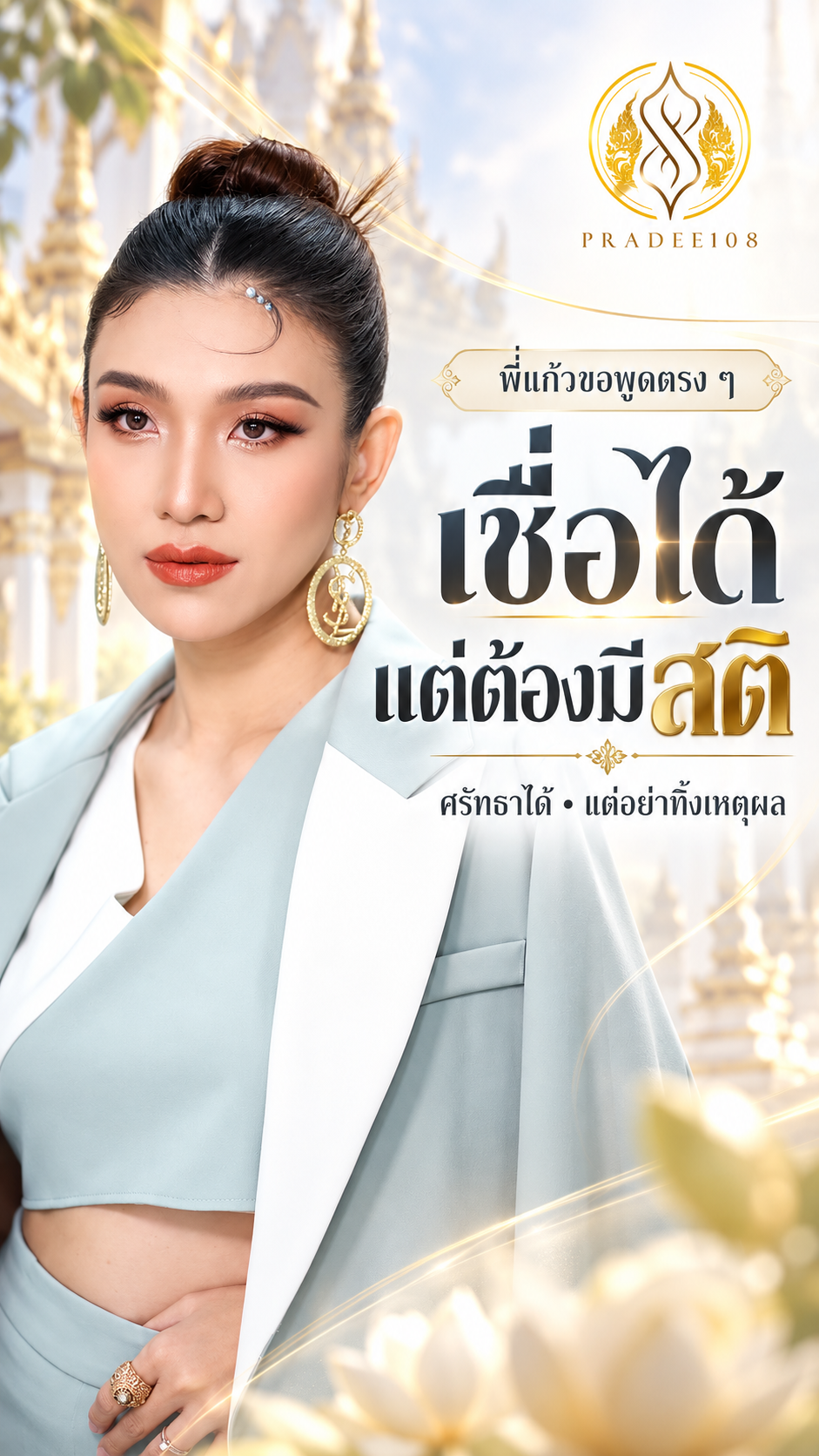
He is a fortune-teller and a fortune-shaper; he does not have to believe everything.
The study of Thai astrology and the belief in sacred things can be carried out in conjunction with the use of reason.
A. Kaew has faith in the stars, good deeds, and the value of Buddhist amulets and relics, but that does not mean that he accepts every claim without consideration.
Because belief is a personal matter, while decisions in life require a combination of information, understanding, and prudence.
Belief is not a cessation of questioning, but a knowing how to use the mind to consider what one believes.
Before believing, you must understand the information.
Many beliefs are passed down through oral traditions, personal experiences, or what is seen through various media.
But what people have been telling each other does not mean that there is always supporting information or evidence.
A. Kaew therefore places importance on studying the information before deciding to believe it, considering its source, reason, and credibility.
Especially regarding matters related to beliefs and faith, listening with an open mind should be accompanied by checking the information; it should not be based solely on the claims of someone or the belief of a large number of people.
Before worshipping an amulet, one must know the origin and purpose of its creation.
The key concept that Ao Kav wanted to convey is that destiny is not something that determines how our lives should be without any choice.
Thai astrology can be used to consider the opportune time or times when caution should be exercised, whether in matters of work, finances, relationships, or daily life.
But the decision still remains the responsibility of each individual.
When you know there is a chance, you should prepare yourself and take action. When you know there are precautions, you should use more caution.
Forecasts should be information to support planning, not decisions that cause us to stop using reason.
Before believing in anyone, one must look at their actions rather than their words.
Faith does not only apply to sacred objects, but also includes the beliefs we have about individuals.
Before trusting someone, Dr. Kaew felt it was necessary to consider whether what that person said was consistent with their actions and whether they were responsible for what they were claiming.
Reputation, position, or credible statements may not be sufficient to judge a person without considering their behavior and facts.
Using mindfulness is therefore important to help us not be influenced by beliefs without proper consideration.
Before making predictions, one must adhere to the principles of science and one must not lose one's composure.
In the field of Thai astrology, Dr. Kaew adheres to the principle of analysis based on the positions of the stars, zodiac signs, and the relationships between the stars according to the scientific method; it does not rely solely on personal feelings or beliefs when making predictions.
The responsibility of a fortune-teller is not only to tell what the client wants to hear, but also to consider the information carefully and convey the predictions in a way that is beneficial for life planning.
Just as with making offerings or worshipping sacred objects, faith can be a source of spiritual strength and motivation, but it should not be used as a substitute for thinking, decision-making, and responsibility for one's own actions.
Because believing in something with value does not depend on how much we believe in it, but rather on how wisely we use that belief.
“I believe Mu. But don’t abandon reason and sanity.”
This is the concept that A. Kaew Nopgae holds, both in studying Thai astrology and in prioritizing Buddhist reliquaries and amulets through the Buddhist Relic 108 website.