




The organizers have news about the amulets.
Do we have to throw away what we have?
When news of a Buddhist artifact or a trend arises, many people may ask themselves whether the object they are worshipping should be kept. This matter should be considered separately, separating the “value of the object” from the “personal matter,” and viewed rationally and with a clear mind.
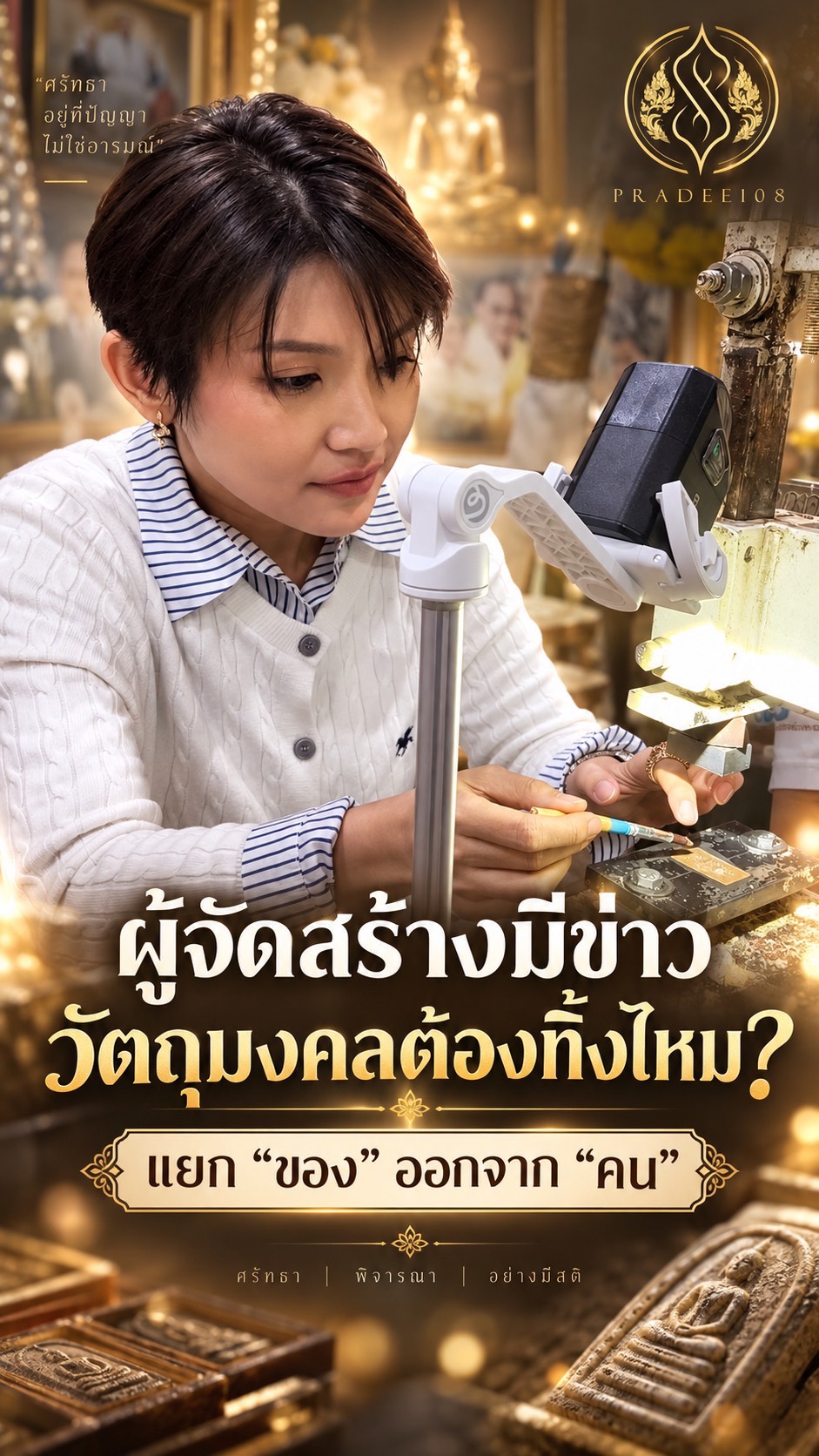
The organizers have news: Do the artifacts have to be discarded?
Recently, a question has been frequently asked: If someone associated with the amulet we worship has any bad news or any behavior that causes the believers to feel uncomfortable, should we stop worshipping or throw away that amulet?
For the glass item, this matter should be considered as two separate issues: “the matter of the amulet” and “the matter of the person”.”
Before worshipping, we should know what we are believing in.
The important thing does not start after the news breaks out, but should begin before making a decision to worship the amulet.
Before making a decision, Gae has to consider who the creator is; what is their way of life and work; are the words they say and their actions consistent with one another? Only then should they proceed to consider the item itself.
• Why was it created with a specific purpose?
• Is there a clear explanation?
• Where is the charcoal or material used from?
• What are the steps and rituals?
• Are there any monks or teachers who have joined the prayer ceremony?
These details help us understand how the objects of worship originated and what their meanings are; they are not judged solely by trends or popularity.
Don't choose just because it's popular.
When a particular type of amulet is gaining popularity, when a large number of people are worshipping it, or when someone says that the particular type of amulet is popular. “Strong” It should not be the only reason for a decision.
If we believe in someone, we should study that person, the background, and understand what we are about to worship.
Because before we place our faith in a single object, we should also know what we are placing that faith in and for what reason.
What if the news comes out later?
When an event or news occurs afterwards, there is no need to immediately judge based on emotions.
We can return to considering the origin, the intention behind the creation, the process of creation, the rituals, and the meaning of that particular object of veneration, and separate these issues from the story of the individual who came after it.
But at the same time, if the situation causes us discomfort or our faith changes, we can choose to act according to our own judgment, without having to judge whether others should believe or act the same way as we do.
Faith is possible, but faith with awareness.
For a glass of wine, faith need not contradict reason.
We can have beliefs, hold on to spiritual anchors, and worship sacred objects while simultaneously studying the origins, verifying the information, and considering it with a clear mind.
Faith is fine, but faith with awareness.